
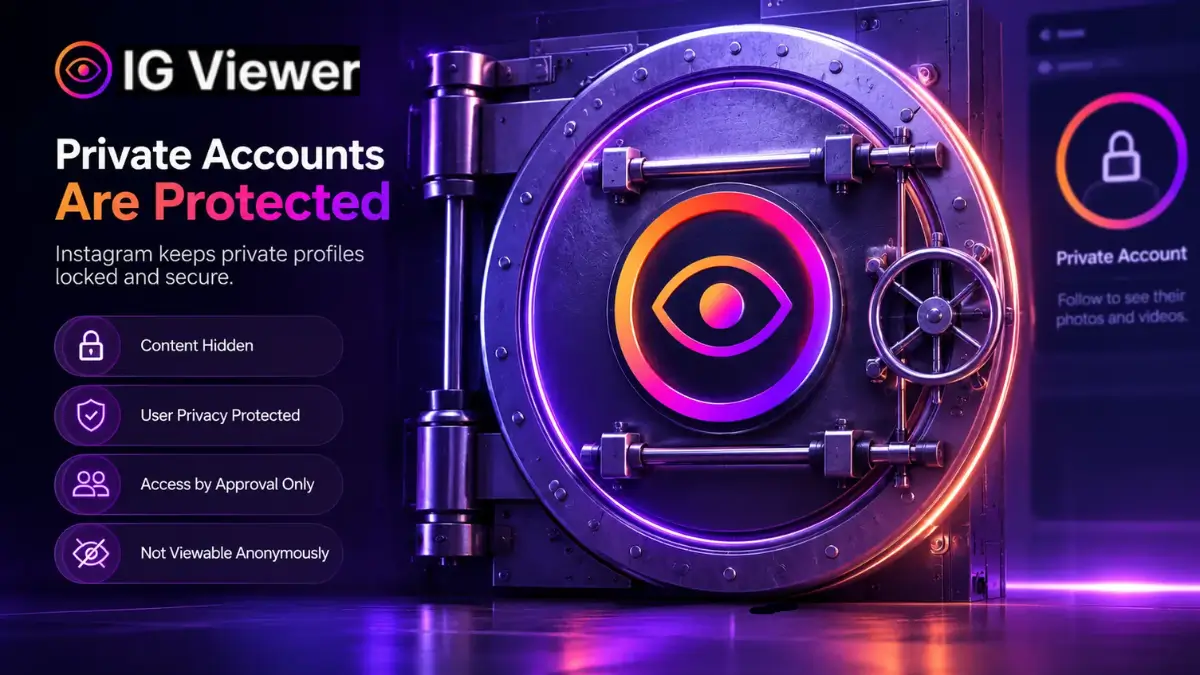
You cannot view private instagram story anonymously through any web-based tool or scraper — private accounts are protected by a follower-authentication check that has no equivalent for an anonymous, unauthenticated request, which is also why any site claiming to unlock private stories is either useless or actively malicious.
It’s one of the most common questions in social media privacy, and for good reason. You search for someone’s profile — an ex, a competitor, an account you’re just curious about — and you’re met with the padlock icon: “This Account is Private.” Naturally, you turn to search and type some version of view private instagram story anonymously, hoping there’s a clever workaround.
There are thousands of results promising exactly that. Glossy websites claim “one-click private story unlocking.” YouTube videos walk through suspicious APK downloads and “human verification” steps. This guide strips away the marketing and gives you the actual technical reality, plus the one legitimate (if tedious) method that genuinely works. If you’re here specifically to check a public account’s stories without logging in, that part is straightforward and legitimate — our anonymous story viewer handles exactly that, and this guide will make clear why it can’t and won’t extend to private accounts.
The short answer: no, with one real exception
Let’s state this plainly: it is not technically possible for a web-based tool or anonymous scraper to view a private Instagram account’s story. If an account is set to private, its media is locked behind an authentication check that has no equivalent for an unauthenticated, anonymous request — no proxy server, browser extension, or “viewer” site can produce credentials it was never issued. There is exactly one legitimate workaround, and it doesn’t involve hacking anything — it involves the account owner actually approving you. We’ll cover why the scam tools fail first, then walk through that real method.
How the private/public check actually works
Understanding why third-party tools fail here requires understanding how the request itself is evaluated.
When an account is public, its stories sit on Instagram’s open content delivery network — any properly formed request for that public username’s media gets served, because there’s no owner-side approval required. This is exactly the mechanism a legitimate anonymous viewer relies on: fetch already-public content server-side, without ever touching the requester’s own Instagram account.
When an account is private, the architecture changes completely. Instead of an open node, Instagram requires the requesting account to be on the target’s approved-follower list before releasing anything. Access resolves down to one binary check: is the requesting account’s ID present in the target’s follower list? If yes, the content is served. If no — which includes every anonymous, unauthenticated request by definition — access is refused. There’s no partial access, no “public preview,” and no technical trick that produces a “yes” for a request that was never authenticated as anyone in the first place.
There's no partial access tier for private accounts — the check is binary, and an anonymous request is, by definition, always on the "no" side of it.
Why public and private are treated so differently
It’s worth understanding why Instagram built the system this way, since it explains why there’s no realistic prospect of this ever changing. When someone sets their account to public, they’ve made an explicit, platform-level choice that their content should be viewable by anyone — that’s the entire meaning of the setting, and it’s why services that only ever touch public content, ours included, aren’t doing anything the account owner didn’t already consent to by flipping that switch.
Private accounts represent the opposite choice, made just as explicitly. Building any kind of exception into that system — even a narrow one, even for a seemingly reasonable use case — would mean the “private” setting no longer reliably means what it claims to mean for every one of the platform’s private users simultaneously. That’s a much bigger integrity problem than any individual curiosity case, which is exactly why Instagram treats it as a hard boundary with no official exceptions rather than a preference with edge cases.
The scams that claim otherwise
If the technology genuinely doesn’t exist, why do so many sites claim they can do it? Because the desire to see behind a private profile is a strong enough psychological pull that it’s profitable to exploit, regardless of whether the product actually works.
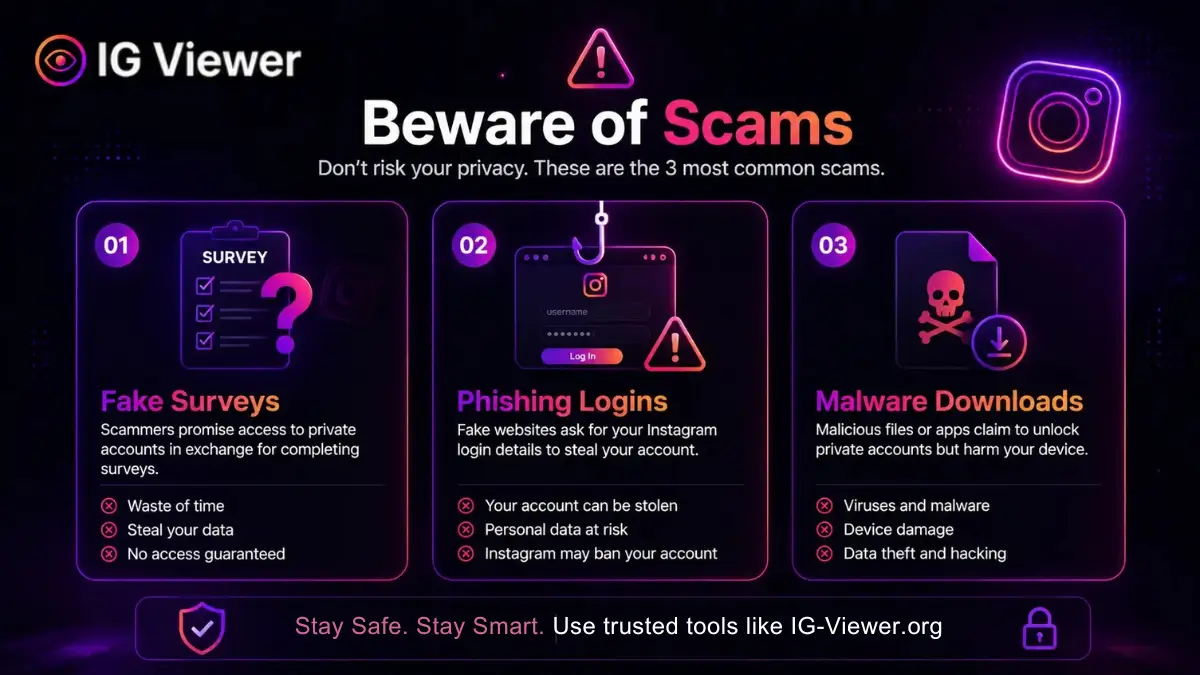
The “human verification” loop. A slick site displays a fake progress bar — “Decrypting… Bypassing firewall… Success!” — then, right before showing anything, demands you complete a survey or download an app to “prove you’re not a bot.” There was never any content waiting on the other side; the operator just earned an affiliate commission for the survey completion while you handed over your email to spam lists.
Credential phishing. A site claims it needs to “route the request through a real account” and asks you to log in with your own Instagram credentials to authorize the search. The login screen is a convincing fake. The moment you type your password, it’s captured — and the attacker uses it to lock you out, hold the account for ransom, or push scams to your own followers.
Malicious downloads. A video claims the only way to bypass privacy is a special desktop program or Android APK. What actually installs is malware — keyloggers, credential stealers, or ransomware, running quietly in the background once you’ve granted it permission.
Paid “premium unlock” subscriptions. A newer variant charges a recurring subscription fee for “premium private account access,” often with a countdown timer or limited-spots urgency framing designed to rush the decision. The payment processes normally, no actual access is ever delivered, and by the time a user tries to dispute the charge, the operator has often already moved on to a new domain with the same offer.
The only real workaround: the burner-account strategy
If third-party tools genuinely can’t do this, how do journalists, researchers, and everyday users legitimately see private content they have a real reason to check? The same way anyone else does: by actually becoming an approved follower. Since a burner account keeps that follow request from being traceable back to your real identity, this is the closest thing to a “workaround” that actually respects the platform’s security model rather than trying to break it.
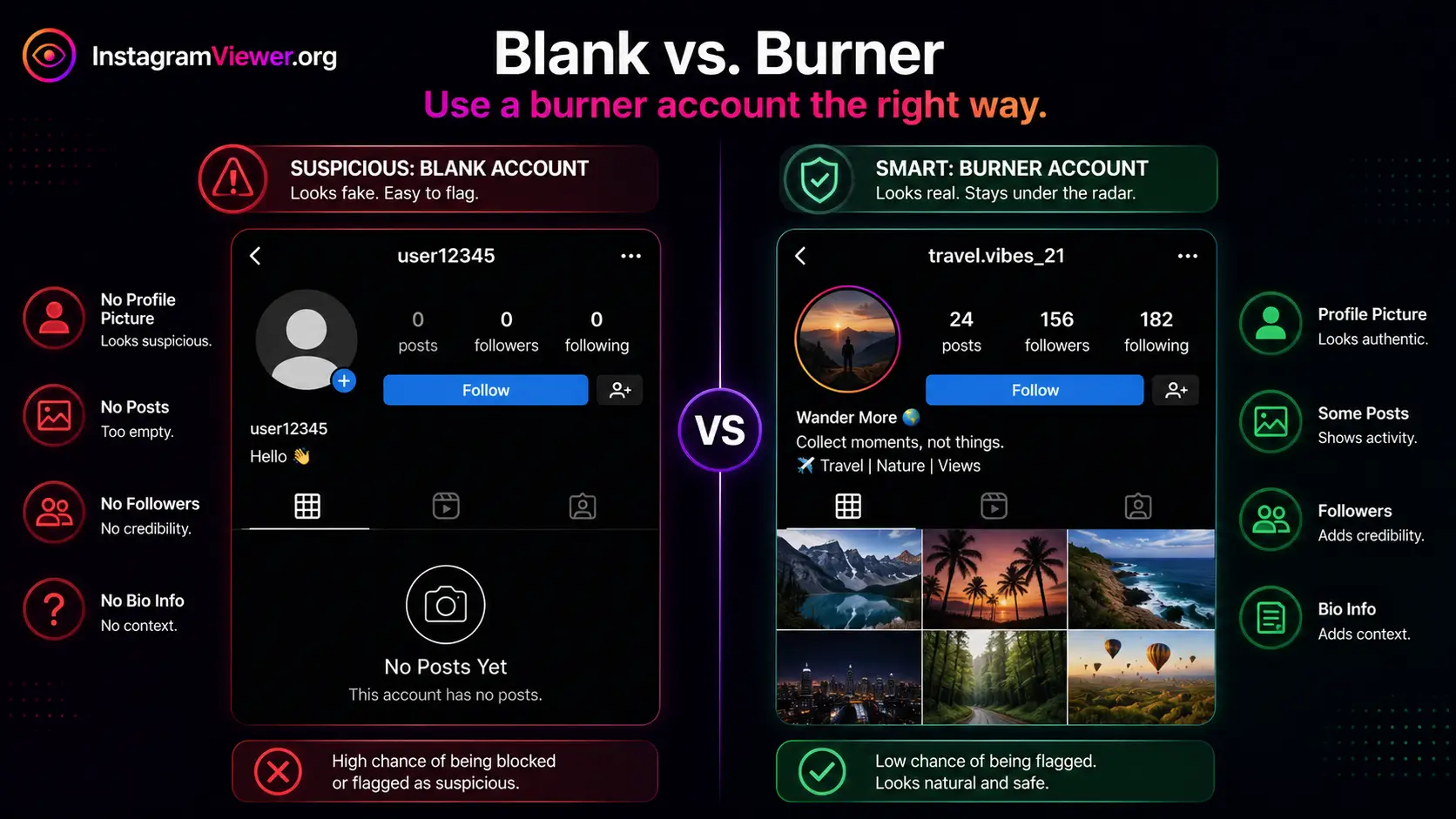
Building an account that actually gets accepted takes real effort — a blank profile with no picture and zero followers reads as an obvious bot and gets rejected on sight.
- Use a dedicated email. Don't link the account to your phone number or your main account's Accounts Center — Instagram's suggestion algorithm can otherwise connect it back to you through mutual contacts.
- Give it a real theme. Faceless accounts get rejected far more often than accounts built around a believable niche interest — photography, a specific hobby, a location.
- Build actual history before requesting. Post several photos over a week or two, write normal captions, and follow 50-100 relevant public accounts. An account that looks freshly created and immediately requests to follow one specific private profile is an obvious red flag to anyone reviewing requests.
- Then, and only then, send the request. Once the account looks established, request to follow the target. If accepted, you now have the same legitimate access any other approved follower has.
There’s a meaningful time cost worth being upfront about, since it’s the actual reason people go looking for a shortcut instead of doing this: a credible burner account realistically takes one to two weeks to build before it looks established enough to be accepted, especially by someone cautious about follower requests. That timeline is inherent to the approach, not a sign you’re doing it wrong — an account with zero history requesting to follow one specific private profile is exactly the pattern a careful account owner is watching for, and there’s no way to compress that trust-building process without making the request look more suspicious, not less.
It’s also worth being clear about what happens if the request is simply declined, since that outcome is common and isn’t a problem to troubleshoot around. A private account owner rejecting a follow request is the system working exactly as designed — it’s their explicit call about who gets access. Sending repeated requests from new accounts after a rejection moves out of “workaround” territory and into something closer to harassment, regardless of the intent behind it.
A quick gut check before pursuing the burner-account route at all: is the account private because the owner is generally selective, or because they specifically restricted you? If it's the latter, building a workaround is worth reconsidering entirely, regardless of how technically achievable it is.
The ethical line
Building a burner account for research or competitive analysis sits in a genuine gray area, but the line between acceptable and unacceptable use is fairly clear once you name it directly. A social media manager building a brand-adjacent account to track a competitor’s private community is a defensible business practice. Using a burner account to get around a block from someone who has explicitly asked you to stop contacting them is not — it’s a boundary violation regardless of the account name attached to it, and depending on the pattern of behavior, it can cross into actual harassment. If someone has blocked you and gone private, that combination is about as clear a boundary as this platform allows someone to draw. Respect it.
What about Close Friends on a private account?
Getting approved as a follower on a private account only grants you access to their standard stories and grid — it does not automatically include their Close Friends content. Close Friends is a separate, manually curated sub-list layered on top of the follower relationship, and the account owner has to add your (approved) follower account to that specific list before the green-ring stories become visible to you. Being an approved follower is necessary for Close Friends access, but it isn’t sufficient on its own. For the full mechanics of how that list works, see our guide on Instagram Close Friends stories, explained.
What journalists and OSINT researchers actually do
It’s worth demystifying this a little, since “OSINT technique” sometimes gets thrown around as if it implies some special technical access. In practice, open-source intelligence researchers investigating a private account work within exactly the same constraints described above — there is no professional-tier bypass. What differs is process discipline: legitimate researchers document their methodology, avoid impersonating a real identifiable person when building an investigative account, and — critically — treat anything they can’t legitimately access as genuinely out of reach rather than escalating to purchased “hacking” services, which are overwhelmingly scams targeting the same desperation this entire guide has been describing. If a private account’s content can’t be reached through a real, disclosed follow relationship, credible investigative practice treats that as the boundary of the investigation, not an obstacle to route around.
Conclusion
The internet runs on the promise of clever workarounds, and it’s genuinely tempting to believe any digital lock can be picked with the right website. For Instagram’s private-account authentication specifically, that promise is false — every tool claiming otherwise is either doing nothing or actively working against you. The only real path is the tedious, manual one: build a credible profile and let the account owner grant access themselves. Accept that some accounts are simply not going to be visible to you without that approval, and treat any site that says otherwise as a warning sign rather than a shortcut worth trying. Protect your login credentials, respect the boundaries a private setting represents, and save your energy for the accounts that are actually reachable through legitimate means. For a broader look at what does and doesn’t count as safe in this space, see our companion guide on whether anonymous story viewers are actually safe to use.
Frequently Asked Questions
Straight answers about how the tool works, what it can and can’t do, and how to use it safely.
Is there any app or website that can actually unlock a private Instagram account?
No. Every claim to this effect is either a data-harvesting scam, a phishing attempt for your login credentials, or malware disguised as a downloader — there is no technical bypass for the follower-authentication check private accounts use.
Is it illegal to create a burner account to follow someone?
Creating an account isn't illegal on its own, but using it to bypass a block or to continue contacting someone who has asked you to stop can cross into harassment, which is a legal matter in most jurisdictions regardless of which account was used.
Will the private account owner know a burner account is mine?
Not automatically, but avoid linking the burner to your phone number, email, or Accounts Center connected to your main profile — Instagram's People You May Know suggestions can otherwise connect the dots through mutual contacts.
Can I view a private account's story if we have mutual friends?
Having mutual followers doesn't grant you access on its own — you still need the account itself to approve your specific follow request. Mutual connections can make an approval more likely, but they don't bypass the requirement.
Does turning my own account private stop tools like yours from working on my stories?
Yes, completely. Setting your account to private is the only switch you need to flip — it immediately locks out every anonymous viewer, scraper, and proxy tool on the internet, ours included, since none of them have a legitimate way around the same follower check covered in this guide.