
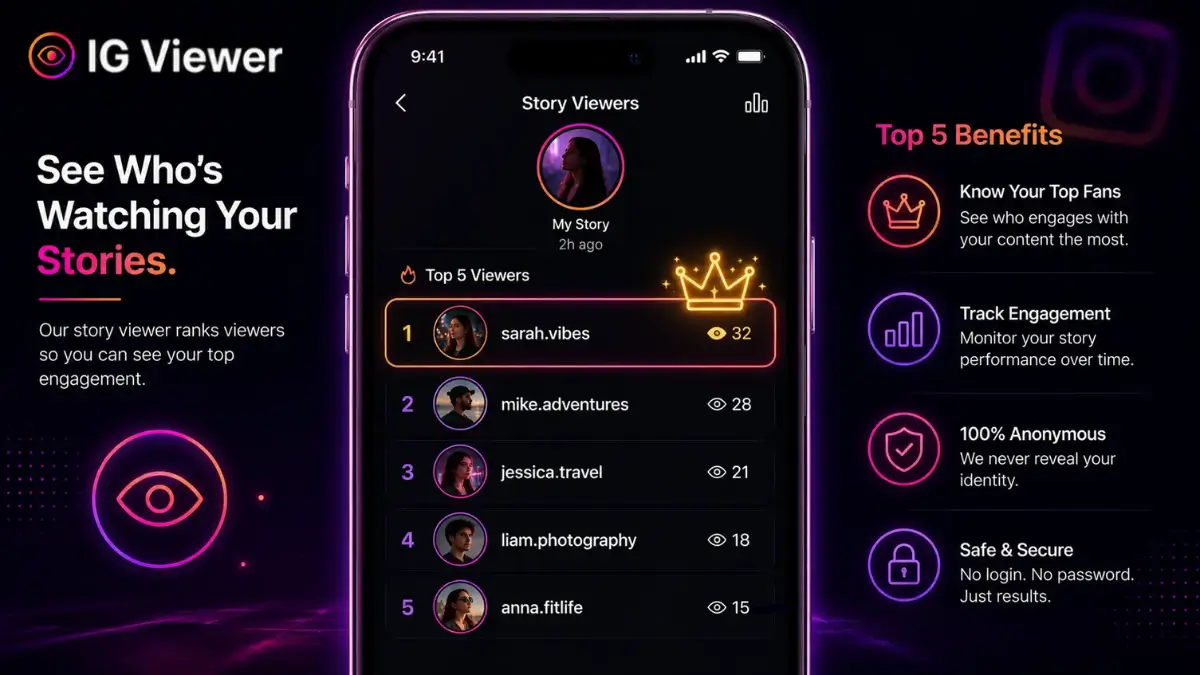
The instagram story view order is not random and not chronological once a story passes roughly 50 views — it's a personalized ranking driven by your own engagement history with each viewer, which is why the same handful of people keep landing at the top no matter what they post.
If you post Instagram Stories regularly, you’ve probably noticed something that feels too consistent to be a coincidence: the exact same handful of people show up at the top of your viewer list, story after story, regardless of what you actually post. Whether it’s a best friend, a coworker, or an ex you haven’t spoken to in months, the instagram story view order rarely looks random once you start paying attention to it.
That consistency is exactly why it’s spawned so much speculation. Does it mean they’re checking your profile obsessively? Does it mean Instagram’s algorithm somehow “knows” who you’re interested in? This guide breaks down what’s actually driving that ranking, what Instagram has confirmed about how it works, and what — if anything — you can do to change it. If you’d rather look at a public account’s stories without ever appearing on their list at all, our anonymous story viewer handles that from the other direction entirely, which is a distinction worth keeping in mind as you read the rest of this.
How the view order evolved
To understand today’s ranking, it helps to know it wasn’t always this way. When Stories first launched, the viewer list was purely chronological — whoever viewed most recently sat at the top, full stop. It was simple and predictable, a straightforward reverse-chronological log.
That approach didn’t scale. As Instagram grew into a platform with billions of active users, a purely chronological list stopped being useful for keeping people engaged. Seeing a random stranger or an inactive bot account at the top of your list doesn’t trigger any kind of psychological payoff — and Meta’s products are built, deliberately, around maximizing the payoff of opening the app. So the company replaced the chronological list with a predictive ranking system: a model that tries to guess who you’d actually want to see viewed your story, and puts them first.
This mirrors a broader shift across nearly every major social platform over the same period — chronological feeds, once the default everywhere, were gradually replaced by predictive ranking almost everywhere data volume made it feasible, because engagement metrics reliably improved when the platform showed people what its model predicted they’d care about most, rather than a plain timestamp order.
The 50-viewer threshold
Here’s the detail most explanations skip: the ranking behavior actually changes depending on how many views a story has.
Under roughly 50 views, the list stays close to chronological — whoever viewed most recently tends to appear near the top, because there simply isn’t enough engagement data yet to justify a heavier predictive re-sort. Once a story crosses that threshold, the list reorganizes and the ranking model takes over completely. From that point on, position in the list is driven by your calculated “relationship strength” with each viewer, not by when they watched.
This explains a common point of confusion: a story with 30 views can look meaningfully different in ordering behavior from the same account’s story that crossed 60 views, even though both eventually get the “same” algorithm treatment. It’s a threshold effect, not a difference in the underlying system.
How the algorithm scores "relationships"
Instagram calculates something like a private relationship score between you and every other account you interact with. Nobody outside Meta has access to the literal number, but the categories of signal that go into it are well understood from years of observed behavior and Meta’s own public statements about ranking.
Direct messaging. Consistent DM activity with someone is treated as one of the strongest available signals of a real, active relationship — arguably stronger than public interactions like likes or comments, since DMs are a much more deliberate form of engagement.
Profile engagement. If you frequently search for someone’s profile, visit their grid, or watch their stories, the algorithm reads that as high interest on your part — and responds by surfacing their views on your own stories more prominently, on the assumption you’ll want to know they engaged back.
Mutual engagement. Reciprocal activity — liking each other’s posts, tagging each other, commenting back and forth — compounds the score in both directions and tends to produce the most stable “always near the top” positioning over time.
Recency, weighted against frequency. A single intense burst of interaction (a long DM conversation last night) can temporarily outrank a slower-but-steadier relationship (a coworker you exchange a comment with every couple of weeks) — but that burst decays quickly if it isn’t followed up on, while the steady, lower-frequency relationship tends to hold its position more consistently over months. This is part of why the same “boring but consistent” contacts often end up more durably placed near the top than whoever you were texting most last week.
The view order is less a ranking of who's watching you, and more a mirror of who you've been watching.
What Instagram has confirmed vs. what's inferred
It’s worth being honest about the limits of what’s actually known here, since a lot of “algorithm explainer” content states inferred behavior as if it were documented fact. Meta has publicly confirmed, in broad terms, that Stories ranking uses a predictive model based on your relationship with the poster and your past interaction patterns — this much is acknowledged directly in Meta’s own transparency materials about how content is ordered across the app.
What Meta has not published is the literal weighting formula: exactly how much a DM counts versus a profile visit, precisely where the 50-view threshold sits (that number is widely observed and consistent across enough independent testing to be treated as reliable, but it isn’t an official published constant), or how quickly a given signal decays. Everything at that level of specificity in this guide, and in every other guide on this topic across the internet, is inferred from consistent, repeated observation rather than sourced from an official technical document — a distinction worth keeping in mind before treating any single claim, including ours, as gospel.
The "stalker" myth, busted
Myth
Whoever's at the top of your story views is secretly obsessed with your profile, checking it constantly without your knowledge.
Fact
The ranking weighs your engagement with them at least as heavily as theirs with you — so it's frequently a reflection of who *you've* been checking on, not the reverse.
This is the single most persistent piece of Instagram folklore, and it’s largely backwards. While repeated profile visits from someone can contribute to the score, Instagram’s ranking system heavily weighs your own actions — your DMs, your searches, your engagement — over theirs. If an ex consistently lands at the top of your list, the more likely explanation is that you’re the one checking their profile, not that they’re quietly obsessing over yours.
Ghost accounts and anonymous viewers
One scenario that genuinely does confuse people: seeing a blank profile with no picture and no followers land near the top of the list. This is typically the result of a third-party tool’s proxy account making the request — since it has zero relationship history with you, the algorithm has no meaningful data to rank it against, and it can land in unpredictable positions, occasionally even near the top, particularly on a story that hasn’t yet crossed the 50-view threshold.
It’s worth being precise here: this is a byproduct of how some tools work, not how all anonymous viewing works. A properly built tool that fetches public story content server-side, without ever authenticating as a bot account inside Instagram itself, doesn’t generate a viewer-list entry in the first place — there’s no proxy account to log, because there’s no account involved at all. That’s the architecture behind our own Instagram story viewer, and it’s the reason “will this show up in their view list” is a fair question to ask before trusting any particular tool.
Not every tool is built this way, and the difference matters more than most people realize. Some cheaper or poorly engineered scrapers route requests through disposable Instagram accounts to make automated requests look “native,” and those accounts absolutely do generate a viewer-list entry — meaning the person you’re checking on can, in principle, see a strange near-empty profile land in their list. If avoiding any footprint at all matters to you, it’s worth confirming a tool actually works via public-page fetching rather than an authenticated proxy account before relying on it.
Does a business account see it differently?
Business and creator accounts see the same underlying ranking logic as personal accounts, with one meaningful addition: Instagram’s “Story Insights” panel, available only to non-personal accounts, breaks out reach, impressions, taps forward/back, exits, and replies as aggregate metrics alongside the ranked viewer list. A personal account only ever sees the ordered names and the raw total — no aggregate breakdown. This is one of the more common practical reasons people convert to a creator account: not the badge, but the extra layer of data sitting on top of the same ranking system everyone else has.
Is Close Friends ranked the same way?
Stories posted to your Close Friends list use the same underlying relationship-ranking model as a regular story — the pool of possible viewers is just smaller and pre-filtered, since only people you’ve manually added can view or appear in that list at all. Within that smaller pool, the same signals apply: whoever you DM, visit, and mutually engage with most still tends to surface near the top. The green-ring audience being curated doesn’t turn off the ranking system underneath it, it just runs that same system over a shorter list. For a full breakdown of how the Close Friends feature itself works — including who can see it and how the list is built — see our guide on Instagram Close Friends stories.
Can you change who shows up first?
If you’re tired of seeing the same person at the top, you can shift the ranking — but it requires actually changing your engagement patterns, not flipping a setting.
- The interaction fast: Stop DMing, viewing their stories, and searching their profile for a sustained stretch (roughly two to four weeks). As your relationship score with them decays from inactivity, their ranking will fall naturally.
- The Restrict feature: Restricting an account sharply limits how much interaction data flows between you, without the social visibility of an outright block — a faster way to push someone's ranking down.
- Hide Story From: The most direct fix. If you don't want a specific person appearing in your viewer list at all, hiding your story from them removes them from the equation entirely — they can't view it, so they can't rank.
The role of Meta's cross-app data
One layer that surprises people: Instagram’s ranking doesn’t live in total isolation from the rest of Meta’s ecosystem. If you’re connected to someone on Facebook, or you message them frequently on WhatsApp, that cross-platform relationship signal can factor into your Instagram relationship score too. This is often the explanation for a family member you rarely interact with on Instagram specifically dominating your story views — the platforms aren’t as siloed as they appear from the outside, and a strong relationship signal on one surface can influence ranking on another.
Conclusion
Understanding the mechanics behind the instagram story view order strips away most of the anxiety that comes from treating it as a mystery. It’s not a leaderboard of secret admirers — it’s a fairly literal, mathematical reflection of who you interact with most, recalculated continuously as your behavior changes. Once you accept that the list is describing your own habits back to you rather than surveilling someone else’s, most of the mystery around it stops being mysterious at all.
For a deeper look at what the native viewer list does and doesn’t actually show you, see our guide on who viewed your Instagram story, and for the broader ranking systems this same logic plugs into across the rest of the app — Feed, Explore, and Reels included — see how the Instagram algorithm works more generally.
Frequently Asked Questions
Straight answers about how the tool works, what it can and can’t do, and how to use it safely.
Does the person at the top of my story views like me?
Not necessarily in a romantic sense — the ranking reflects mutual engagement (DMs, profile visits, likes, comments) between you and that person, weighted heavily toward your own recent behavior. It's a relationship signal, not a crush detector.
Can I see the exact view order for a story I already deleted?
No. The ranked viewer list only exists while the story itself is live or briefly afterward via your archive; once the underlying story data ages out, the ordered list is no longer accessible.
Does replying to someone's story move them up my list faster than DMing them?
Both count as direct engagement and both matter, but plain DM frequency has historically been treated as one of the strongest signals, since it's a clearer sign of an active one-to-one relationship than a single story reply.
Why does a stranger with no profile picture sometimes appear at the top?
This is almost always a fresh or low-activity account with no engagement history with you, often a proxy used by a third-party viewing tool — the algorithm has no relationship data to rank it by, so it can land in unpredictable positions, including near the top, especially before the 50-view threshold kicks in.
Does the order update in real time?
The order can shift as new views and engagement come in throughout the 24 hours a story is live, so refreshing the list later in the day can show a different arrangement than you saw right after posting.